Couples and family consultation
When every conversation ends in conflict, defensiveness, or silence
When the same conflicts repeat, every conversation can quickly turn into defensiveness, blame or silence. A joint session offers a way to look more carefully at the interaction between you without assigning fault.
- Format
- Couples and family consultation
- Fee
- UAH 2,000
- Duration
- 60 minutes
- Location and schedule
- For couples and family concerns · format and participants are agreed separately
You may recognise some of these experiences
- you return to the same conflict again and again;
- it is difficult to hear each other without becoming defensive;
- emotional distance is growing;
- boundaries, responsibilities, money or daily life are difficult to discuss;
- the relationship changed after relocation, the birth of a child or prolonged stress;
- you need more clarity about the future of the relationship.
What can be explored in therapy
- the recurring cycle of conflict and mutual defence;
- ways of expressing needs and hearing the other person’s response;
- boundaries, responsibility and expectations within the couple;
- emotional distance, closeness and changes after significant events;
- the possibility of restoring contact or making a clearer decision about the future.
What the first session is like
Both sides matter in a joint consultation. My role is to help make the interaction more visible, not to decide who is right.
- we clarify what each person brings to the meeting;
- we agree who will participate and which format is possible;
- we discuss professional boundaries and confidentiality when several people are involved;
- we identify what may be useful to explore without promising that the relationship will continue.
04
How I work with a couple
A psychodynamic understanding can make patterns of defence, closeness, distance and unspoken expectations more visible. The focus is the dialogue between you and the possibility of hearing one another more precisely.
- no search for the guilty person and no alliance with one partner against the other;
- attention to both people’s boundaries, needs and responsibilities;
- no guarantee that the relationship will continue or reach a predetermined outcome.

About the practitioner
About me
Yuliia Dicherenko
Psychologist · Candidate psychotherapist
I am Yuliia Dicherenko, a psychologist and candidate psychotherapist. In joint consultations, I draw on a psychodynamic understanding of relationships, attachment theory and a clear professional frame.
- Master’s degree in Psychology
- Over 3,500 hours of practice
- Regular supervision
- Personal therapy
- Continuing professional education
05
Relevant training and credentials

Psychoanalytic Diagnosis and Attachment Theory
View document ↗
Basic Level in Symbol Drama: Integration, Resources and Relationships
View document ↗
Transference, Countertransference and Dream Interpretation
View document ↗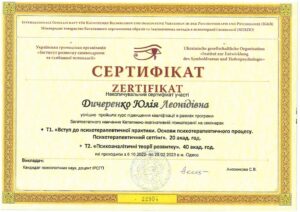
The Psychotherapeutic Process and Psychoanalytic Theories of Development
View document ↗06
Related articles

Love Does Not Require You to Give Up Yourself
Boundaries, safety and the right to remain yourself in a close relationship.
Read article →
When There Is No Empathy or Safety in a Relationship
Psychological violence, manipulation, the right to take distance after conflict and the recovery of personal boundaries.
Read article →
Relationships as a Value and the Psychologist’s Main Instrument
A personal reflection on non-judgemental acceptance, human contact and why the therapist’s personality matters beyond the consulting room.
Read article →
Therapy Is About Contact
Why therapy is shaped not only by what a person says, but also by how they enter into contact, relate to the process, its boundaries and their own feelings.
Read article →FAQ
Frequently asked questions
Do both people need to want to save the relationship?
No. What matters is that both people are willing to take part in the conversation, while the decision about the future may remain open.
Will the psychologist take one person’s side?
My role is to hold the frame and help make the interaction visible, not to determine a winner.
Can we attend if we are considering separation?
Yes. The work may offer more clarity about what is happening, but it does not guarantee that the relationship will continue.
Can one person come first?
One person can request an individual session, but that is a different format focused on that person’s experience.
Who should attend?
The participants are agreed separately according to the situation.
How is the format agreed?
During the first contact, we clarify who will attend, whether the meeting is online or in person, and other practical details.
How is confidentiality agreed when two people attend?
The confidentiality framework for joint work is discussed and agreed at the outset so that it is clear to both participants.
Next step
The first meeting is a place for a clearer dialogue
You do not need to know the desired outcome in advance. You can begin with a question about the format and a brief note about what keeps repeating in your conversations.